Grant Recipient
Wagehe Raufi
In her artistic practice Wagehe Raufi (*1990, Dissen am Teutoburger Wald) translates found or self-produced objects into digital representations and, in a reverse process, digital images into analogue forms. As a comprehensive body of work, the resulting sculptures, video works, and installations open up spaces of reflection and experience, in which the digital and the material are not portrayed as opposites. Instead, the digital is conveyed as an extension of the material, an impetus for questioning our perceptions, attributions of meaning, and relationship to time and space.
Raufi is an alumna of the University for Art and Design Offenbach am Main. In 2018 she studied at the Central Academy of Fine Arts Beijing in China through a DAAD fellowship. Her works have been shown in solo and group exhibitions at institutions, including Kunsthalle Wilhelmshaven (2025), Kunsthalle zu Kiel (2025), Kunstverein Arnsberg (2024), Historisches Museum Frankfurt (2024), Kunstverein Siegen (2020), and Frankfurter Kunstverein (2019). She has been awarded residencies, including in Willingshausen (2022) and at the Bauhaus Dessau (2017), has received the Federal Prize for Art Students (2021), and has been selected for the Werkstattpreis, Kunststiftung Erich Hauser (2026). In 2024–25 Raufi lived and worked for a year in the studio of Hessische Kulturstiftung (Cultural Foundation of Hesse) at Cité internationale des arts in Paris.
Hessische Kulturstiftung (HKST) During your scholarship in Paris, you explored how urban space is constructed through memory and perception. What interested you about this topic? And did you manage to find anything close to an answer?
Wagehe Raufi I am interested in how spaces today are structured, not just physically, but also how they are constantly being medially constructed and overwritten. Images, social media, and repeated narratives create a stage on which certain constructs of urban public space and intimacy are reproduced and consistently reaffirmed.
The powerful the impact of this image production became particularly evident to me in Paris. The city appears as a beautiful, timeless, encrusted historical façade—a layer that is almost frozen but is still continually reforming. This outer surface is selective. It excludes anything that does not fit into a certain narrative and covers over the realities of lived experience. As a result, an order or system is produced that maintains a stable form for a certain moment in time, both on screen and in physical urban space. But I was disturbed by the discrepancy between the experience of space and this staged visuality and visibility. When everything is shown, shared, and filtered, the notion of interior space also shifts. Protected spaces become penetrable or disappear entirely, while visibility becomes the expectation.
I came closer to an answer about how urban space is medially constructed. I did this less by looking for the “true Paris” and more by exploring the points where this façade begins to crack. In my work I do not try to reproduce images but disrupt and destabilize them, revealing what slick representations leave out and what resists permanent preservation.
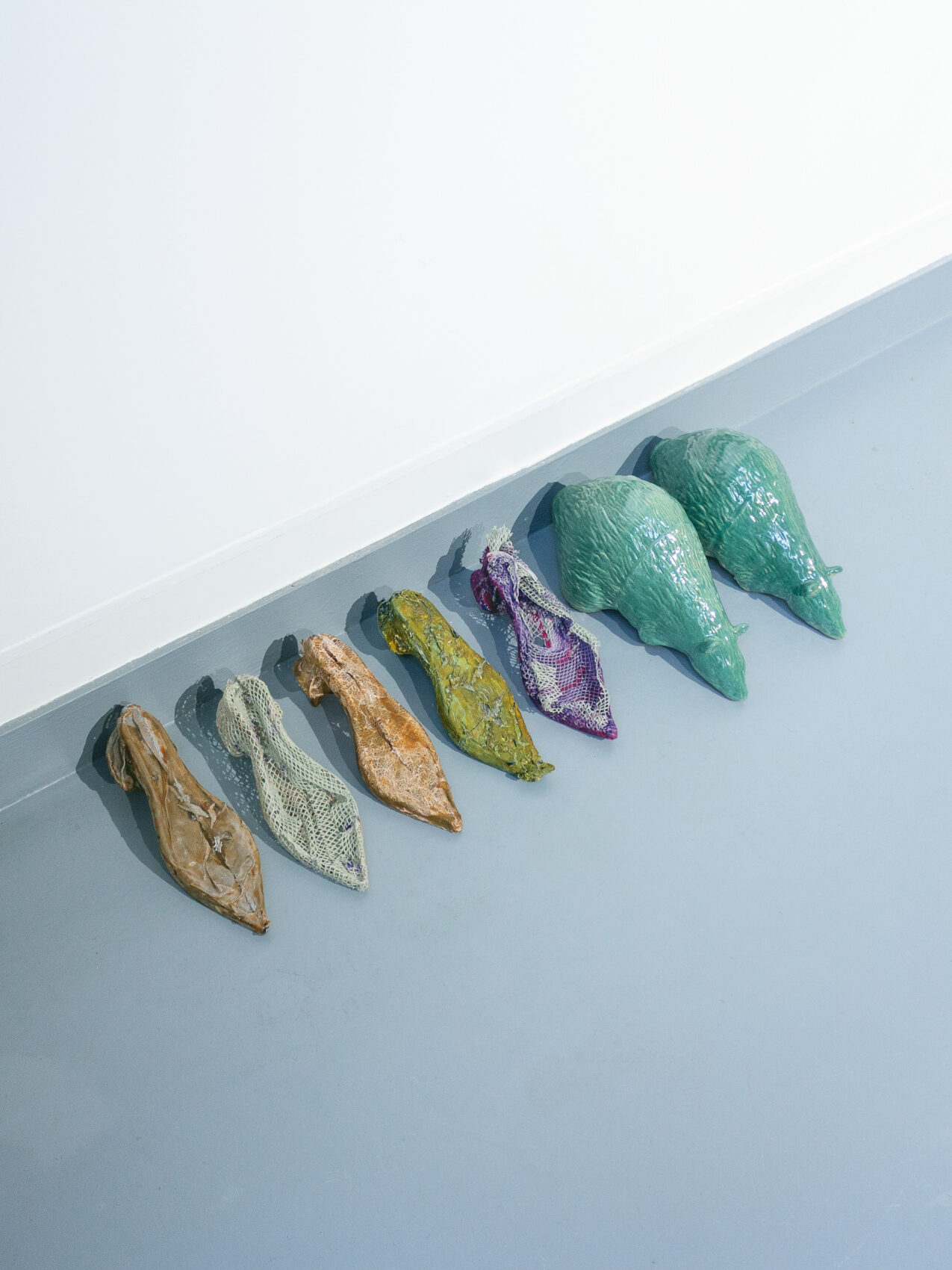
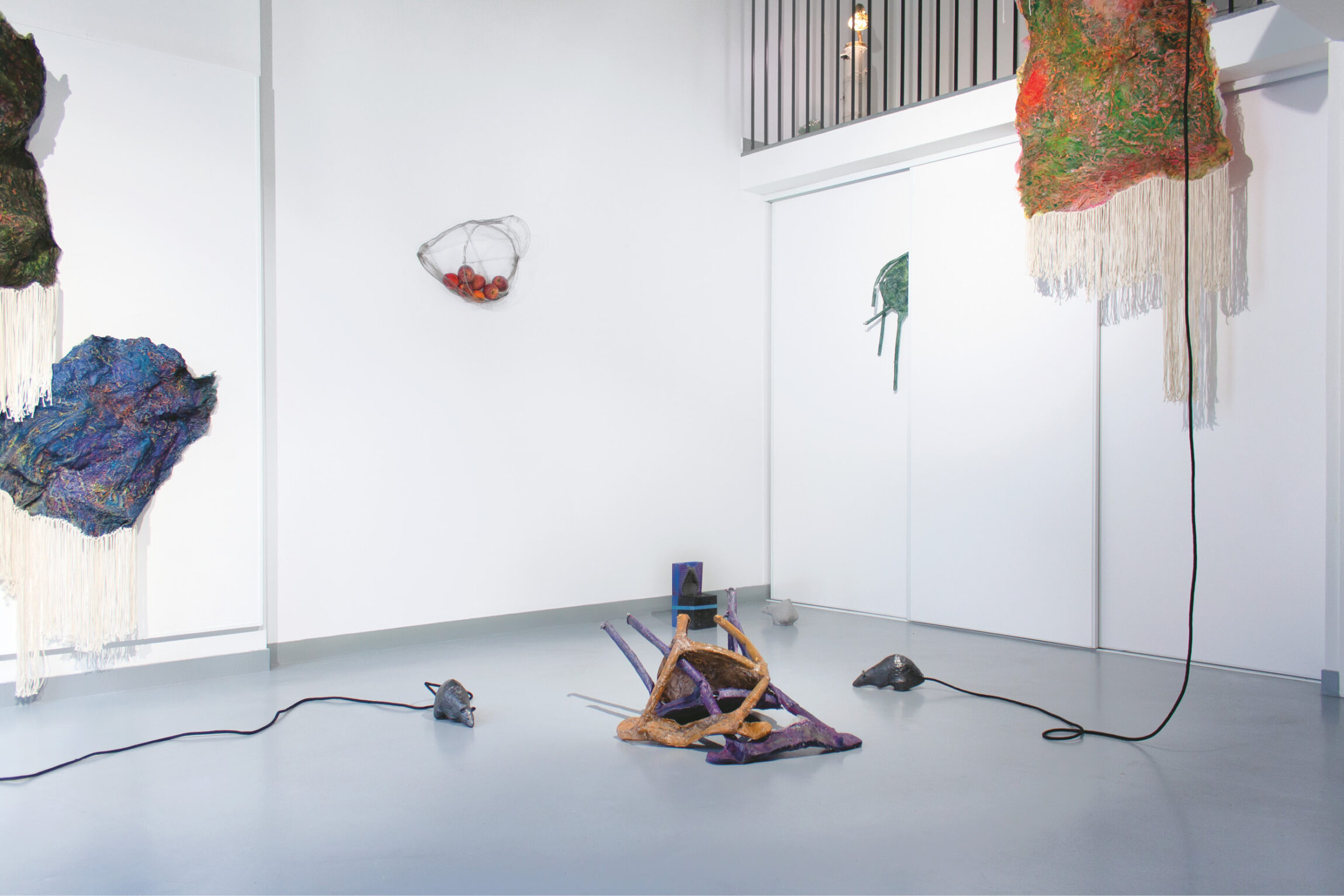
HKST During your open studio you had ceramic rats take over the floor of the Cultural Foundation of Hesse studio in Paris, and in the summer of 2025 you installed a hermit crab as the occupant of the Kunsthalle zu Kiel, as part of a large-scale multimedia artwork. You’ve also included moths and creatures that recall walking stick insects in some of your older works. What attracts you to these kinds of protagonists?
Raufi I’m interested in protagonists that are overlooked, suppressed, or considered disruptive, because they have a different relationship to their environment than we do. They move in parallel spaces, transit zones, revealing how space functions outside our system of order.
The moth follows the light, leaves behind holes, and produces little unstable territories. The hermit crab can only remain alive if it’s flexible. For this crab, transformation is routine, not a state of exception, and the walking stick insect is like a balancing oracle, feeling its way, almost as if giving a performance, always just about to disappear. The rat traverses the city on a level that we barely see. It dominates the underground, utilizes points of fissure and intermediary spaces, while also carrying highly loaded meaning. The myth of the rat king creates a repulsive image, a collective projection of the uncontrollable. By this I mean the horrifying specter—also witnessed as a rare phenomenon—in which multiple rats bind themselves together into a ball with their tails, appearing to function as a single body. I’m drawn to the way this image hovers between a cultural construct and an actual biological possibility, between a projection of “pure terror” and a phenomenon that may, in rare cases, occur. It reveals a contemporary sense of uncertainty, because narratives and stories often have a stronger impact than verifiable facts. Out of this lack of clarity we quickly define bodies, denigrating or excluding them, and pushing them out of spaces of inclusion, if they don’t conform to our categories and systems of order.
These animals are seldom human favorites, but for that very reason they are so close to us. Using these creatures, I can negotiate themes of ambivalence, exclusion, and resistance without having to focus on people.
HKST At different times the hermit crab has been described as your “alter ego.” Is this an appropriate characterization?
Raufi Yes, to a certain extent. The hermit crab is not a self-portrait for me but an ideational figure, a model for existing in a state of transition between protection and movement, adaptation and alienation. It only survives when it finds a home. And as soon as it grows, it must leave its home. It’s permanently searching for a new shell. For the crab, protection is necessary but never constant or stable. It is a provisional state. The housing that it finds is preformed, having a history of its own. It comes with its own conditions, almost like a contract that it must enter into, if it wants to continue to exist. Precisely this process shapes its identity, because it always must conform itself to something that does not originate from itself. These are the kind of states that I am interested in talking about—about spaces, materials, and medial shifts; about wandering between an outer shell and an inner life, between the things that sustain you and the things that can be taken away at any time.
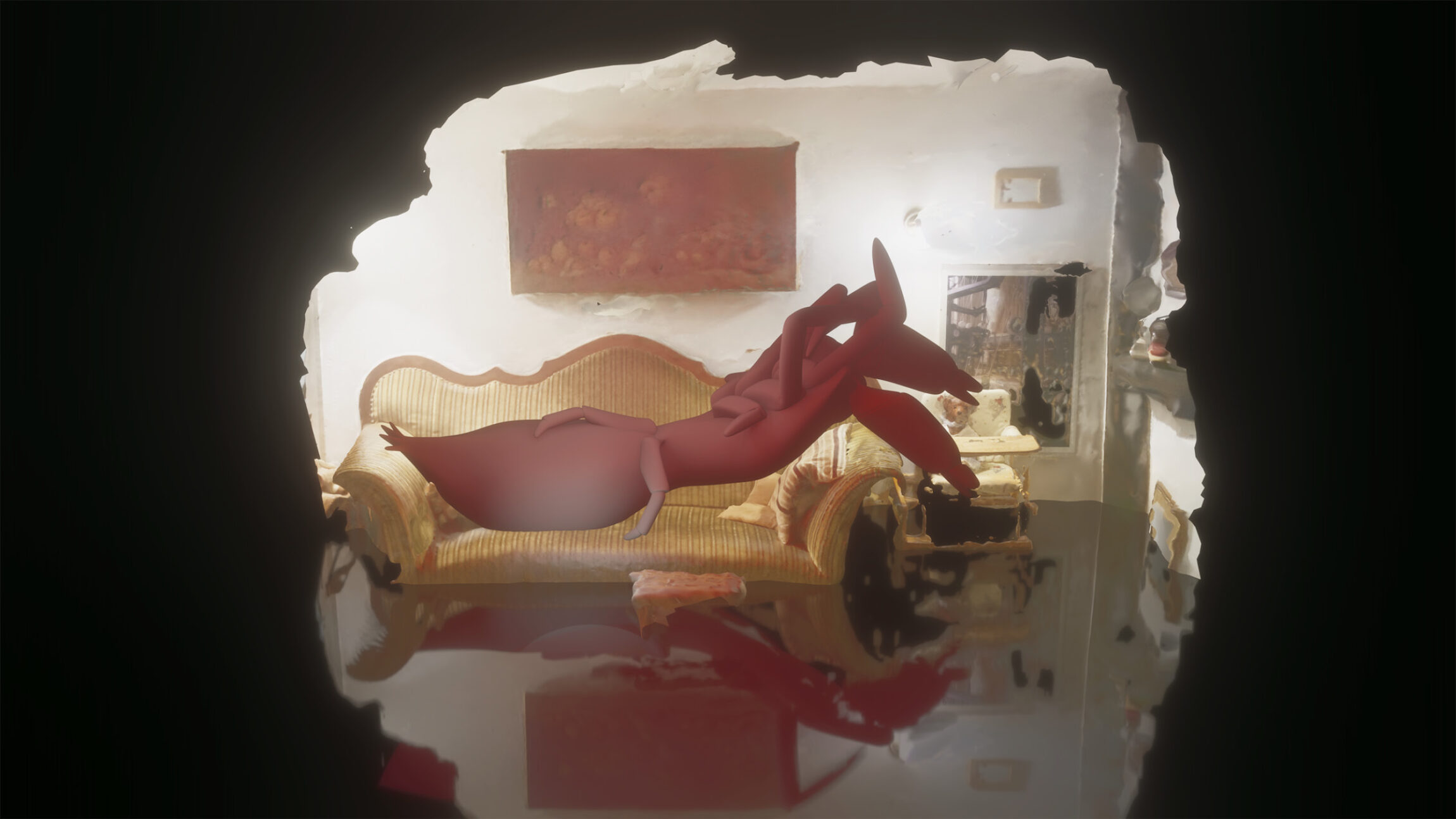
In Ornamental Hermit, a video installation that I created in 2022 during my residency in Willingshausen, I inserted a digitally rendered hermit crab without a shell into the space of the old shepherd’s cottage, which I lived in during the residency. This was a building that shifted due to age—cramped, creaky, and full of the historical traces of earlier occupants. At the same time, the building carries the romanticized image of artist residencies, the idea of retreat and “true” concentration. In this village residency, one’s living quarters and visibility are intertwined. Introspection and exposure coexist simultaneously. In my video work, the hermit crab is stuck in this very same situation, which offers temporary comfort, but it is also a stage. In the video, this interplay shifts and turns into a nested narrative involving bodies, the digital hermit crab, and this historical home.
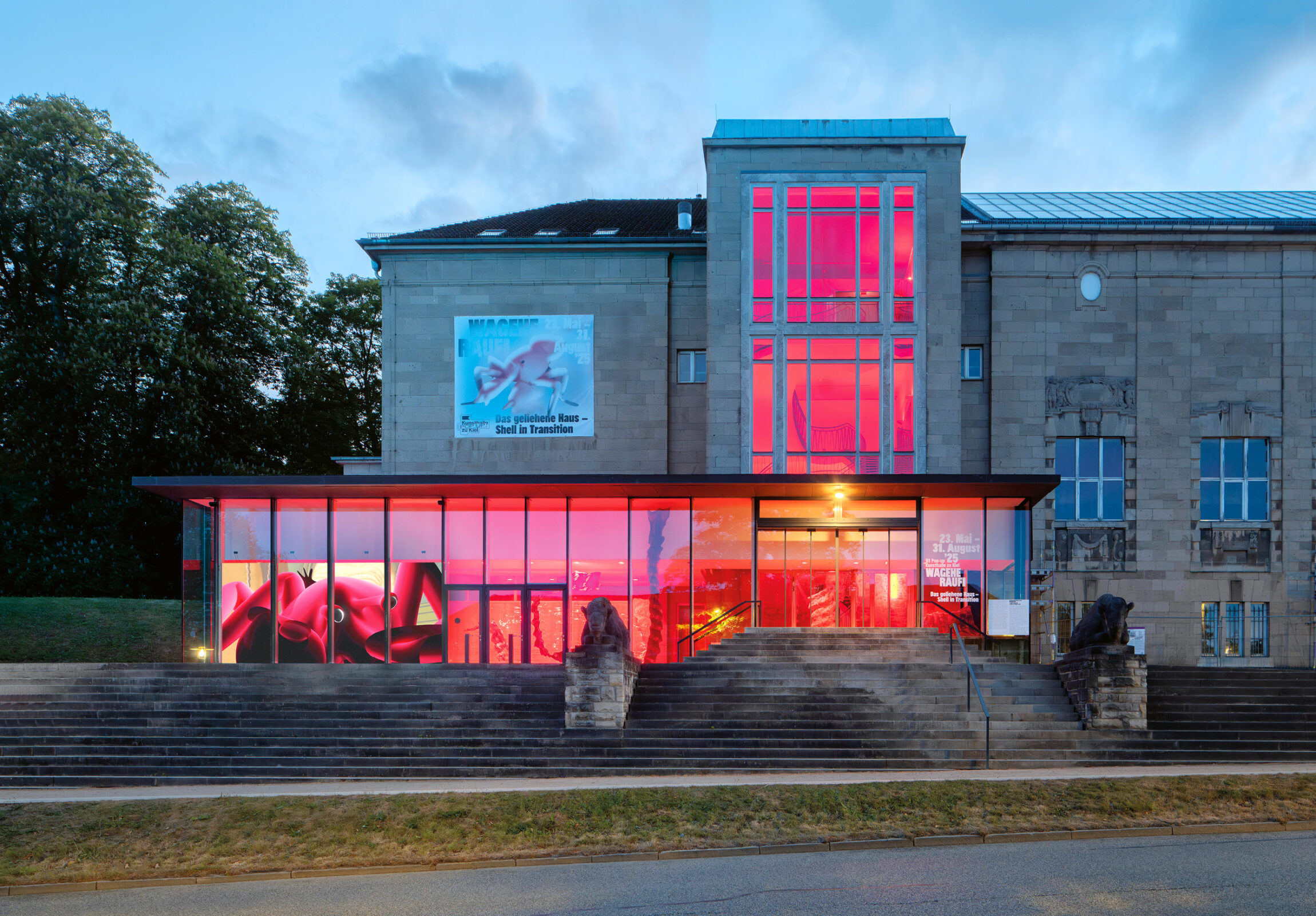
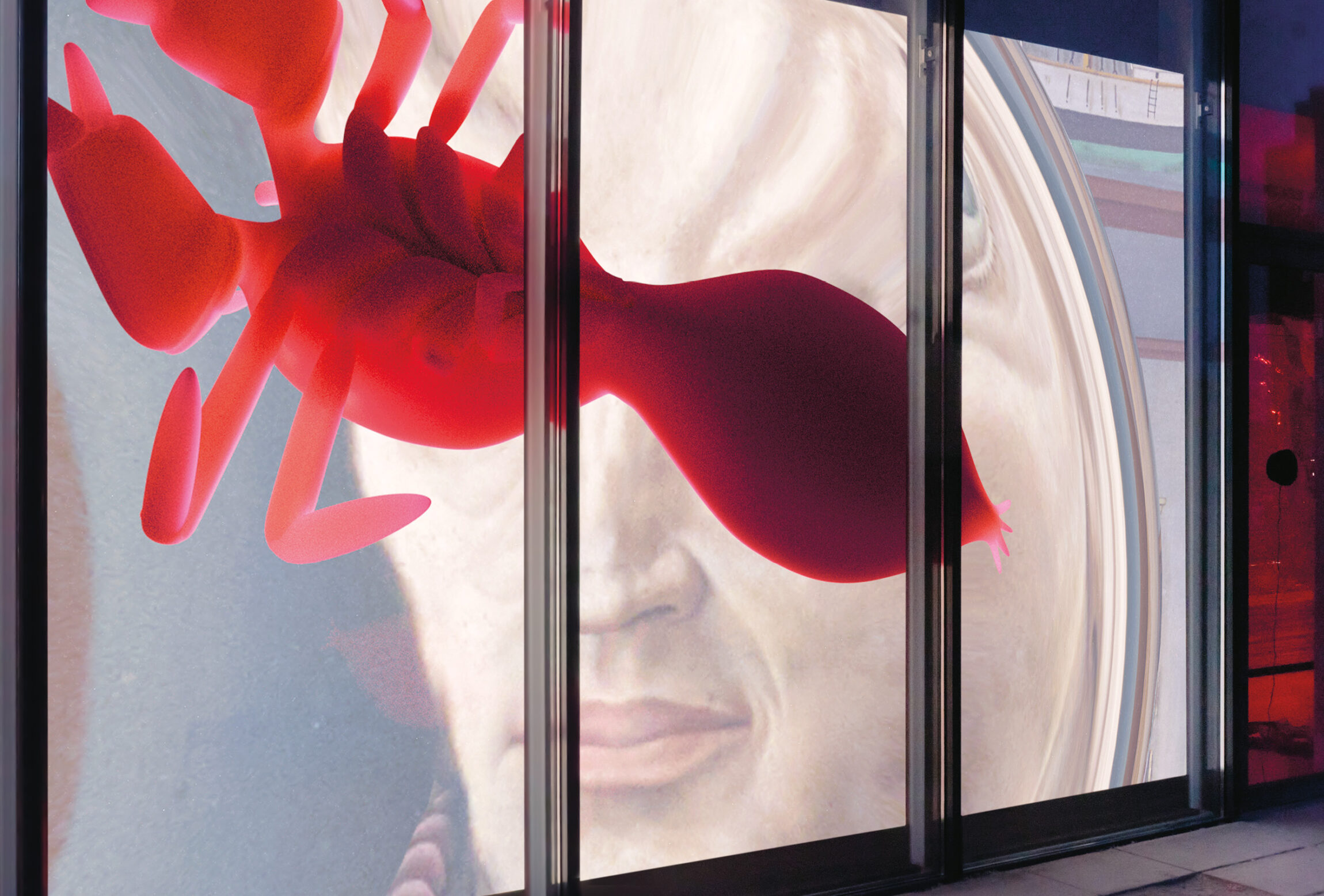
In 2025 this tension was expressed in a spatially and institutionally very concrete situation. The Kunsthalle zu Kiel stood empty due to renovation. It was a museum as a shell without its body of exhibitions, without an inner life. The hermit crab continued its search and found a provisional home in the glass front building as a large-scale work on a LED wall, which was visible from the outside around the clock. The supposedly protective shell suddenly functioned like a terrarium—transparent, publicly accessible, visible to observers. The work created life on the inside that was simultaneously open to all.
For that reason, the hermit crab characterization applies to my work, not because the hermit crab is me, but because it embodies the things that happen with interior spaces when the exterior shells are only stable in a provisional way, and visibility is no longer the exception but a requirement.
HKST Why is transformation such a core theme for you?
Raufi Transformation is core for me, because my work usually centers around a moment of shift, a point where something cannot quite take form or loses its form: granulates bubble up; clay disintegrates; gel-like materials collapse; digital models overlap, fragment, and shift their logic. These situations demonstrate that form is always constituted by time, pressure, environment, and relationships.
This has a structural dimension for me. Protection can often be conceived as a solid wall, but it is more like a thin sheath that can tear at any moment. It is the same with belonging, which seems stable until conditions change, and suddenly it is retracted, redistributed, relabeled. Interior spaces are no longer a given. Instead, they are reconstituted and regulated in a way that dictates who can enter, who is visible, and who must remain on the outside.
HKST How do you see the difference between analogue and digital transformation or translation processes?
Raufi Analogue and digital processes differ for me largely in the way that they generate resistance. In analogue processes resistance lies in the materials, in their immediate reactions: expanding, contracting, tearing, or drying. These reactions can’t be undone. I work less from an idea of form and more from what a material permits and how it interacts with space and its surroundings.
In a digital context, resistance is situated within the logic of the system and the interface. Models can be opened, layered, or reset, without anything really getting destroyed. For this very reason, in this context I need mistakes, gaps, and friction—moments when the image loses something and becomes fragile. The moment digital ruptures become physical, that is, when I turn them into objects that can be haptically experienced, the logic of translation changes. In that moment translation is no longer a representation but an intervention in both systems.
HKST As you have already indicated, you sometimes like to use unconventional materials for your sculptures—granulate, hydrogels, or gelling agents that can’t be completely controlled. Why? What is more important to you, the artistic production process or the final object?
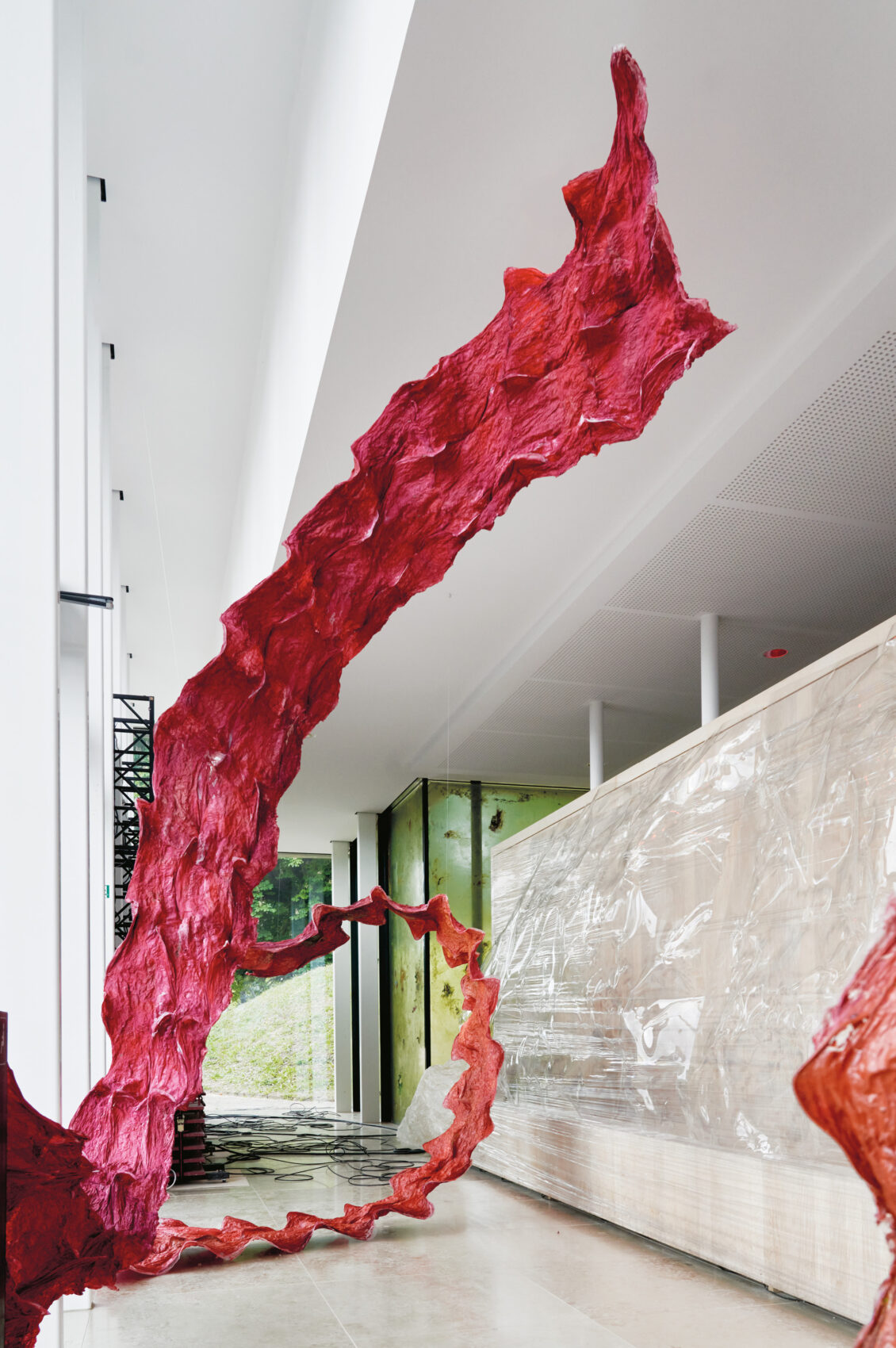
Raufi I often think about crusts. They occupy a boundary but are not a seal. They form, thicken, tear, fall away, and then form again. In my works, crusts are deposits, protective layers, and breaking points all at once.
This is why I work with materials that never achieve a point of stability. They react to the environment, to time, humidity, and pressure; they develop their own agency. My working process becomes a kind of experimental setup, in which I am not the only determinant; the material, space, and situation are co-determining factors.
I am interested in the moment in which control shifts and becomes visible, making form negotiable. The finished object is not an end point but momentary state. Many of my works are open-ended. They don’t try to hide this instability but try to keep it visible as part of their logic.
HKST You draw inspiration from your environment, from literature and film. How do you select the elements of your digital assemblages? What criteria do you use?
Raufi I don’t make my selections based on clear motifs but on resonance. I am interested in fragments that resist clear categorization or remain contradictory. In my digital assemblages, I am less concerned with coherence than with friction—with points where meanings shift or unsettle one another. What matters to me, is that something remains open—a residue that can’t be fully explained—and leaves space for what the viewers bring to the work.
HKST What would you consider the core of your work? Has it changed in recent years?
Raufi The core of my work lies in an ongoing process of formation, disintegration, and reorientation. It is its own cosmos, onto which contemporary uncertainties are inscribed through materials and space. I used to avoid narrative structures. Today I am more drawn to fragments of narrative structures, because they can offer orientation in our uncertain times. This shift has made my work more open, and more oriented towards relationships. I am increasingly concerned with how forms of cohesion develop—not as a fixed body but as a framework that can function as a support without determining outcomes.