Grant recipient
Johannes Büttner
In his films, performative formats, sculptures, and installations, Johannes Büttner (b. 1985 in Frankfurt am Main) devotes himself to exploring material and sociocultural realities. He examines how technologization and digitization create value and transform work and asks how new forms of work interlace with neoliberal ideology, the spread of conspiracy narratives, authoritarian forces, and utopian models. He is also interested in how emancipatory counter-communities evolve within these formations.
Büttner has taken part in exhibitions at such venues as Kunstraum Mitte, Berlin (2026), K21 Düsseldorf (2026), KW Institute for Contemporary Art, Berlin (2023), Literaturhaus Berlin (2022), Kunsthalle Mainz (2021), A Tale of A Tube, Rotterdam (2020), Dok.fest Munich (2025), and the 16th Istanbul Biennial (2019). He was awarded a work grant by the Stiftung Kulturfonds (2022/23) and the Los Angeles residency grant in Günsterode (2023). In 2023/24, on a grant from the Hessische Kulturstiftung, he travelled to Serbia and Croatia to investigate the self-proclaimed libertarian microstate “Liberland” and to Kenya to accompany two bitcoin activists who regard cryptocurrency as a means of evading and reorganizing existing financial systems.
Hessische Kulturstiftung (HKST) This June, the Buchhandlung Walther and Franz König publishing company is releasing Knowledge, a book introducing key works of yours of the past years. In it, you begin by describing your artistic practice as a kind of journey without a map. In your engagement with socioeconomic phenomena often highly complex in nature, to what extent do you allow yourself to be guided by spontaneous encounters, by process, even by chance?
Johannes Büttner (JB) Chance encounters and encounters that emerge from the inner dynamics of the work are my most productive moments. What I’m referring to here are situations where I suddenly find myself in places or constellations that came about from a chain of events that could neither have been planned nor deliberately researched. They’re not the result of a strategy or method; they just happen.
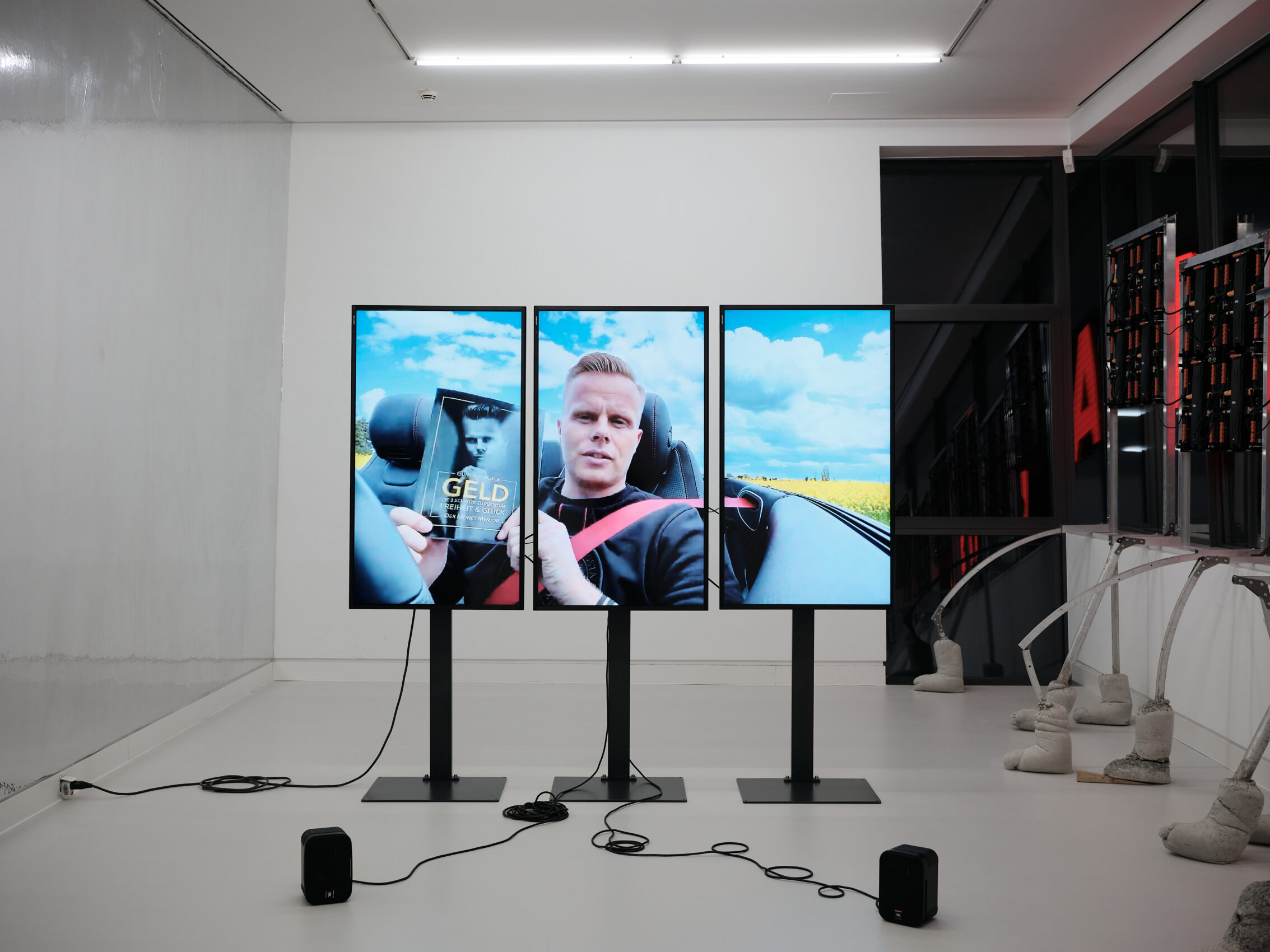
Sometimes the impulse also comes from the protagonists of my projects. Rather than me looking for something or someone, something or someone finds me. In the case of the online coaches who became part of the installation Higher Potential at the Kunsthalle Mainz (2021), this was very distinct. They wanted something from me. They reached out to me by way of social media ads and promised to change my life, heal me, optimize me. What interests me as the point of departure for a work is to take that promise seriously in that moment and understand it as a form of utopian narrative.
In the case of David, the character in Soldaten des Lichts (Soldiers of Light, 2025)—that’s the film I made with Julian Vogel—lines of that kind overlap. David and I knew each other from primary school. Years later, one of said coaches introduced him to me as “Germany’s best nutrition expert”. Then I saw on social media that he was using conspiracy narratives to sell products. At the time, Julian and I were in an ongoing discussion about libertarian and authoritarian movements. In moments like that, various movements intertwine without their having progressed towards a clear result from the beginning.
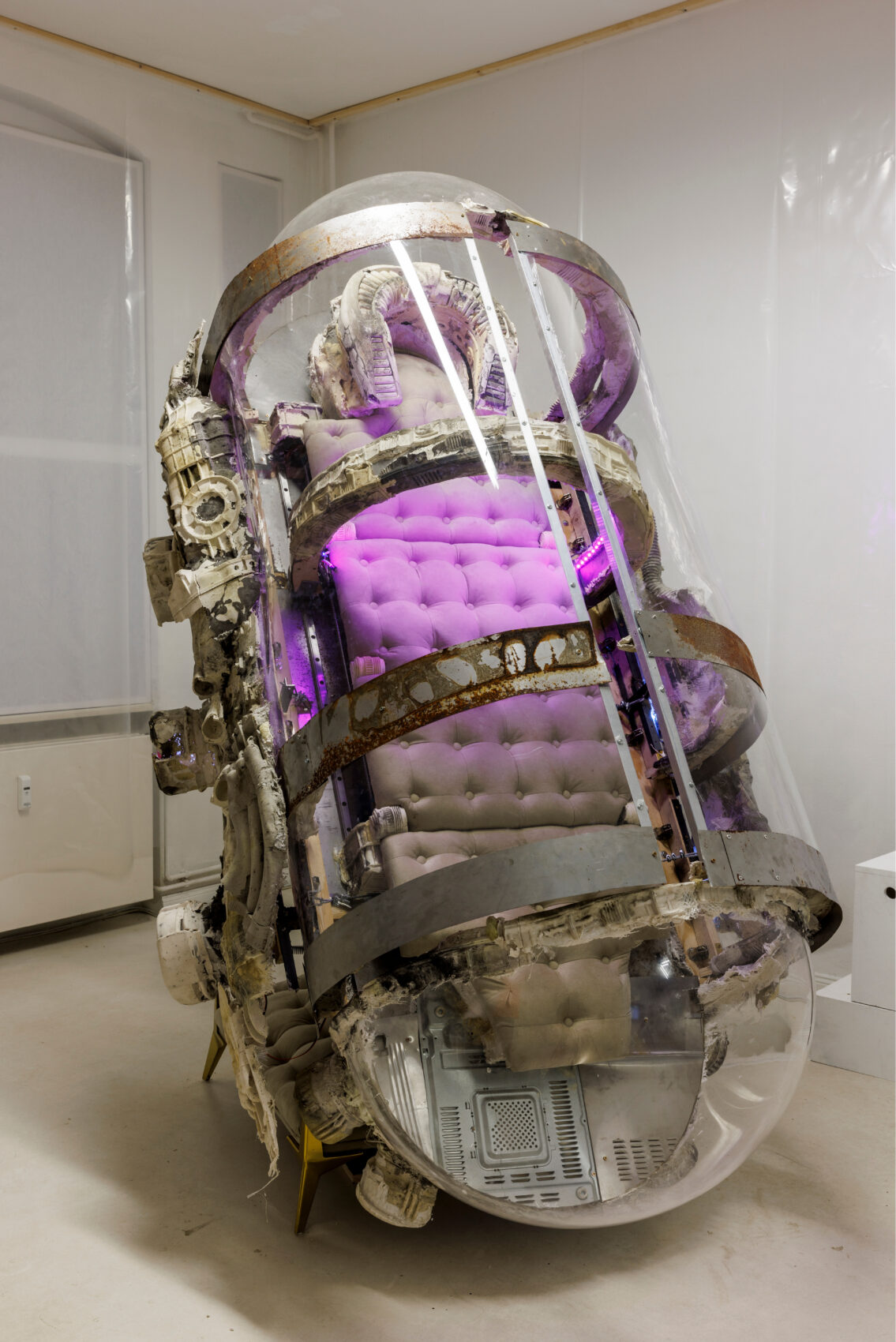
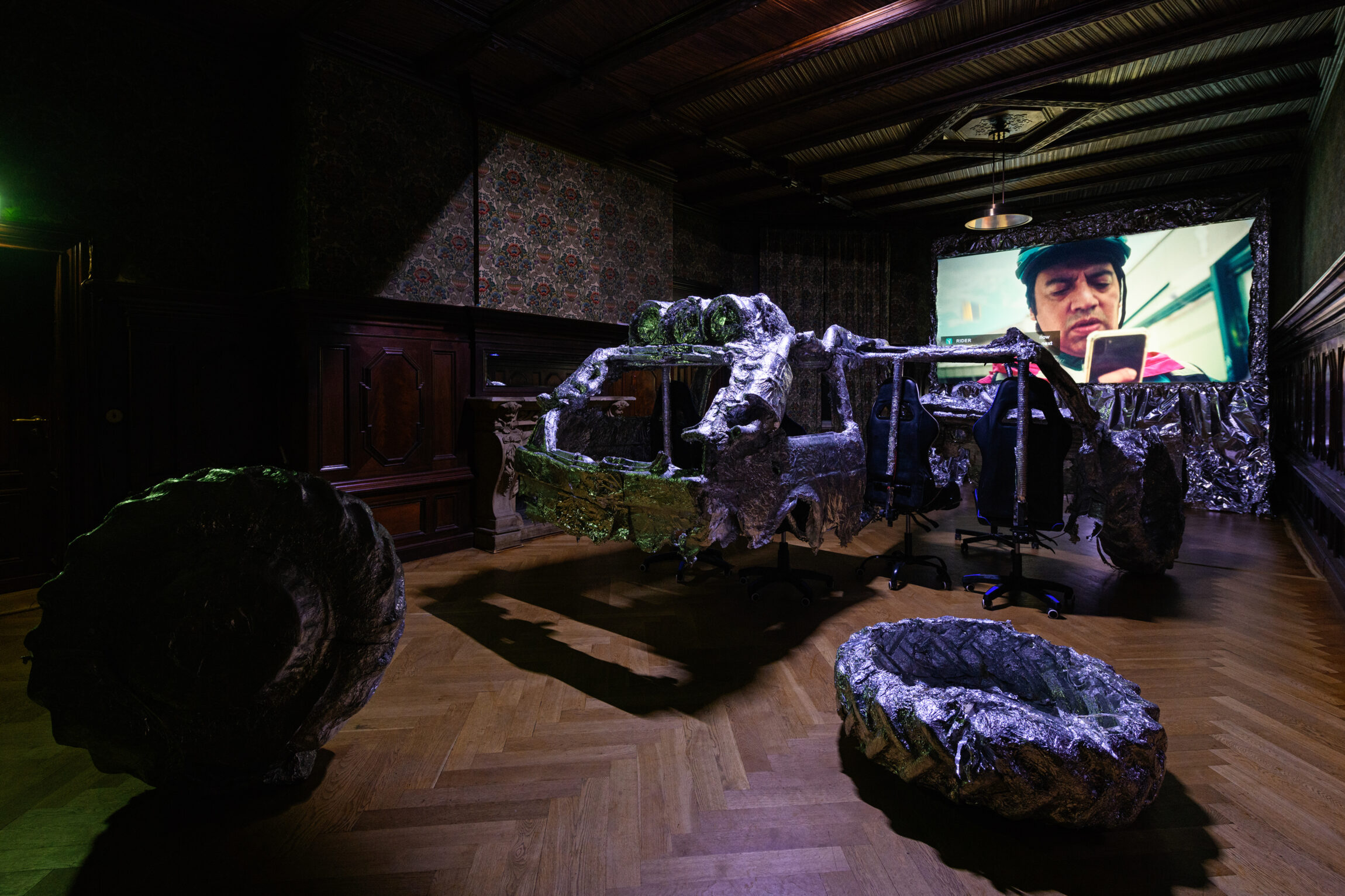
And just like the various forces that impact the works, the results of the works also take on different forms. In addition to the cinema versions of the films, installations also always evolve in which I arrange the material differently and process it further. In Soldaten des Lichts, for example, what evolved was a kind of so-called medbed—a science-fiction-inspired paramedical device that sings the healers’ general terms and conditions from the film.
HKST Already from your answer, it follows that many of your projects develop out of collaborations with people outside the art world. What do you find more interesting: these peoples’ personalities or their life and work realities?
JB I’m primary interested in the roles and functions people adopt and perform in their respective contexts. That’s often closely related to their work. In other words, I’m interested in how a person acts as a worker, businessperson, preacher, or coach and in the products that come about as a result—and not so much in the person’s inner psychological life or linear biography.
Biographical aspects do play a role, but more as a part of subjectification processes that give rise to certain attitudes and practices. I mean, not as finished narratives but as something that becomes apparent in certain situations.
I can’t say in general what my respective interest is. It shifts, depending on who I encounter and what that person embodies in a certain situation. That’s where my own involvement comes into play. I’m not just a passive bystander but also bring my own interests and perspectives into the situation, and they play a role in structuring what I see.
There’s also a question of responsibility in all of this. I work with people whose positions I don’t necessarily share; in fact, whose positions I even reject to an extent. Nevertheless, my part is to take these constellations seriously and not be too quick to disambiguate them.
HKST How do you encounter people who are involved in movements you view critically or reject entirely?
JB I try to encounter them openly. That doesn’t mean to be neutral or ignore my own perspective. Like I said, I come into the situations with my own predispositions, attitudes, and blind spots, but above all also with my own interests.
So for that reason, the whole thing often starts with a very precise conversation. I explain what I’m working on, what I’m interested in, and show earlier projects or provide access to them. At the same time, I try to convey what I’m specifically interested in about the respective people and their practices and try to understand whether they actually see themselves mirrored in those practices.
It’s also just as important to be open about the contexts where I’ll be showing my works later and how the works might be read in those contexts. In a sense, it’s a kind of negotiation. Not only do I enter the protagonists’ world, but they also enter mine by showing themselves, becoming visible.
In that sense, the works are not to be understood as finished results, but as attempts to find orientation in such constellations.
HKST It’s already discernible from what you say that a key aspect of your art is the concern with work and production. What is it exactly that appeals to you about these things?
JB I’m interested in work because it’s not just something we do, but something that forms us. It organizes our time, our body, and our attention and decides what becomes visible and what disappears. In that sense, it’s not just about production but about which reality even appears.
The way we work inscribes itself in our perception, our relationships, our desires. It leaves traces behind not only in infrastructures and products but also in our souls and in what we consider possible. I’d say that economic logic even extends into how we feel, how we decide, how we hope.
It’s not so much the individual field of work as this penetration that I’m interested in. In other words, how certain conceptions of efficiency, growth, or self-optimization are mirrored in very different contexts and are sometimes no longer even recognizable there as such.
Artistic work isn’t separate from that. On the contrary, I also observe myself in these structures. It’s a privileged state that allows me to take the time to pursue things I can’t immediately cash in on. At the same time, precisely that manner of proceeding isn’t innocent but comes with a responsibility.
For me, that means to focus not only on people whose work realities are precarious or invisible, but also on the places where ideologies solidify. In other words, to go where certain conceptions of work, value, and life are produced and taken to an extreme, even if it’s unpleasant.
Often these margins are revealing because things become apparent there that are often more opaque in the middle of the dominant society. And they’re not just something taking place on the outside. What becomes apparent are things that come right from the core. They’re a mutation, an intensification, sometimes a derailment of what’s already there.
HKST As you say, you—like all of us—are a part of the structures whose idiosyncrasies or deficits your works call attention to, whose idiosyncrasies or deficits you actively use, if not to say exploit, for your work, for instance in the performance Untitled (Delivery) (2017) and the video installation The Factory (2020) …
JB While I’m working, I think a lot about how I myself behave in the systems I’m working with. That is, I don’t just think about calling attention to the systems, but also about how I behave in them. I think about what hierarchies I reproduce, where inequalities come about, and where it might be possible to change those inequalities. My work doesn’t occupy a place outside these phenomena but is, like I said, enmeshed in them.
In The Factory I worked with people who offer their services on Fiverr. They perform small, clearly defined jobs that can be carried out online. The name of the platform goes back to the price a job was originally supposed to cost, five dollars. Many of the people who offer their services live in the global south. I was interested in how work is organized under these conditions and how the workers conceive of themselves within this framework. As workers, as entrepreneurs, as part of a global market?
Together we developed and produced a science-fiction film. From the beginning, there was this hovering question of how I deal with the inequalities that structure this type of work, inequalities that—rooted in colonialism—have become more and more established over time. I didn’t pay them according to the usual platform prices, but the way I would like to be paid for comparable work. And we deliberately handled some of the payments outside of Fiverr. By doing so, we deprived the platform of its share of the pay.
In Untitled (Delivery) I used delivery apps to have food deliverers come to the exhibition space while I was reading from Neal Stephenson’s 1992 novel Snow Crash. The book describes a cyberpunk dystopia that seems eerily related to our present-day world. In it, socially and democratically legitimized institutions have been privatized; private security companies have taken the place of the police. The pizza service Cosa Nostra Pizza guarantees delivery in 30 minutes and if it’s late you’re allowed to execute the deliverer.
To the audience, this performance revealed a situation that otherwise goes unnoticed. The deliverers performed simultaneously as service providers and as protagonists of a performance.
I created the decisive difference by using the chat function—in other words, the very channel otherwise used only to give the deliverers instructions. There I explained to them that this was a performance. By doing so, I was giving them a choice in how they wanted to deal with the situation, for instance by deciding to leave the food outside the door and not enter the room.
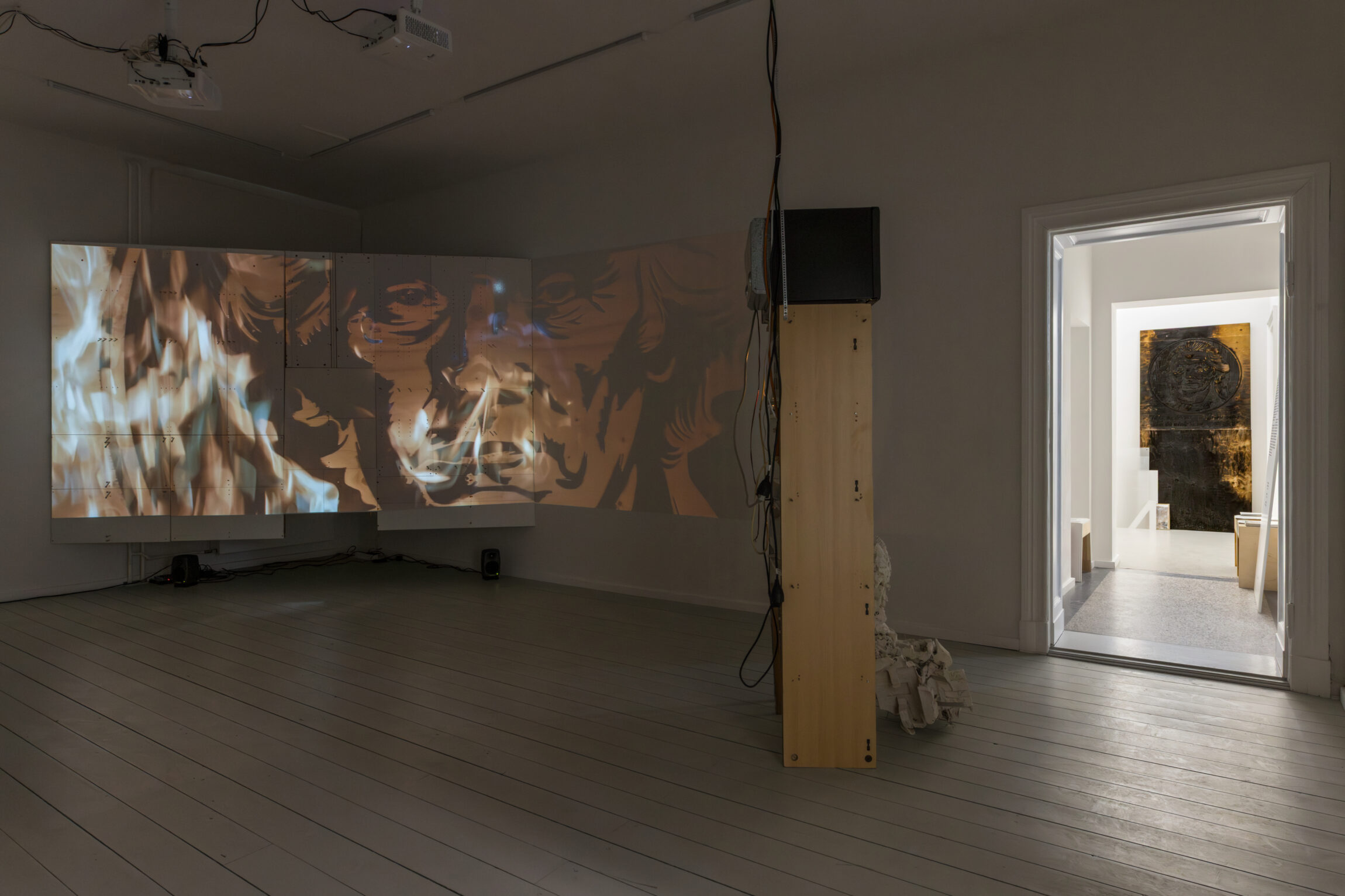
These are the kinds of shifts I’m interested in. Moments in which I can briefly confuse a platform’s logic or turn it against its own function. They’re not major disruptions, just minor interventions. But they show that these systems aren’t completely airtight. In the film Platform (2022), which developed from that performance, Steffen Köhn and I returned to the idea of hacking platform logics and briefly exposing them to their own inherent power structures.
I’m not interested in presenting my own actions as morally superior, but rather in creating situations in which these issues come up. My works don’t exonerate the audience. The members of the audience have to find their own stance. Many people resist or even get angry.
HKST In the video installation L’État c‘est moi (The State Is Me, 2026) you offer insights into the libertarian pseudo state “Liberland” located between Serbia and Croatia, one of the places you visited on your travel grant. As in Soldaten des Lichts*—in which you accompany protagonists of the “Königreich Deutschland” (“Kingdom of Germany”), a meanwhile prohibited sect of the “Reichsbürger” (“Reich Citizens”)—you allow the participants to have their say off-screen, but entirely uncontextualized and apparently unfiltered. In other words, you do not offer any unequivocal evaluations of their ideologies or interpretations of reality. Is that a strategy for putting the viewers in a position of having to think for themselves and taking a share of the responsibility?
JB Just because there’s no off-screen commentary doesn’t mean the works go uncommented on. The comments just take a different form. The choice of situation, the montage, the duration of the takes, the choice of what is shown and what isn’t shown: those are all forms of commentary, but ones that, rather than explaining, serve to structure and expose.
There’s also the aspect that, in L’État c’est moi, the right-wing libertarian project “Liberland” is confronted with a regional folklore tradition, the busójárás. What the two have in common is a form of LARP (live-action role playing)—a way of playing with reality by performatively creating political conceptions, myths, and identities.
I’m interested in the impact that has on the viewers. The work doesn’t provide them any guidance; they have to react to what they see on their own. This robs them of the sense of safety they would get from a voice that explained and classified what’s going on in the work. And it reveals that understanding is not a neutral act, but always also the adoption of a stance.
Precisely in the case of statements made by protagonists indicating misanthropic or misogynous attitudes, this causes a certain sense of unease. The works don’t offer a stable standpoint from which an unequivocal assessment is possible, but call on the viewers to take their own involvement into account.
I almost always feel a need, an impulse to take a stance. The question, rather, is when and why I give in to that impulse. Often it’s really a desire for a kind of self-reassurance that I’m on the “right” side. That’s easy to communicate, and it jibes with a logic according to which one’s own attitude is a form of self-promotion.
I’m more interested in what happens when you omit that gesture. When you don’t immediately make yourself understandable but leave the situation ambiguous.
HKST Would you describe your work in general as political or more as an analysis of social and economic forms and ideologies?
JB My work is political because it focusses on the conditions under which societal realities are created: on work, value, ideology, and the structures that underpin them. An economic system based on competition and constant growth necessarily brings about the exploitation of human beings, animals, and the ecological foundations of life, but also of the social relationships and forms of subjectivity that give rise to and stabilize those very conditions. A preoccupation with these conditions means not only to criticize them but also to look for possible ruptures.
That’s not me looking at these conditions from the outside. I work within them and am a part of them.
At screenings, people often ask me what a person can do to counter the spread of conspiracy narratives and the rise of the right wing. I’m not so much interested in countering these contents as in pointing out the conditions that create and stabilize the respective narratives.
Against that background, demands for isolated corrections fall short of the mark. The socialization of living space and essential goods, for example, is an important step, but not enough in and of itself. If you take structural power relations seriously, the question also arises as to the ownership and control of key infrastructures, especially on the part of large tech companies, as well as the extreme concentration of wealth. And ultimately it also touches on matters of dispossession and redistribution, not as moral gestures but as structural necessities. What it comes down to is not just regulating the foundations of this order but changing them radically.
*Soldaten des Lichts is available in the ZDF Mediathek.