Scholar Ilknur Koçer
Born in the German city of Kassel in 1988, author and illustrator Ilknur Koçer shines a spotlight on the complex interrelationships between migration, work, social inclusivity, discrimination and racism. In her work, she pays particular attention to how labour migration not only affects individual life courses but also shapes the collective consciousness. Her creations also reflect on the value ascribed to work in various contexts and on the often overlooked contributions made to our society by female migrant workers.
A graduate of Kunsthochschule Kassel art school, Ilknur has regularly published pieces in a variety of German and international magazines and newspapers since 2017. Some of her works have also been displayed in museums such as the Weltkulturen Museum in Frankfurt am Main (2025), the Kleist-Museum in Frankfurt an der Oder (2023), the German National Library in Frankfurt am Main (2021/22), the Museum für Kommunikation Berlin (2021) and also at the Haus der Berliner Festspiele theatre (2017). Ilknur Koçer received a scholarship from the Hessian Literature Council in 2022 and was awarded the Lion-Feuchtwanger scholarship the following year. She also travelled through Japan in 2025/26 with a scholarship from the Hessische Kulturstiftung foundation.
Hessische Kulturstiftung (HKST) 2027/28 will be the first time that Japan is part of the Hessische Kulturstiftung’s residency scholarship programme.* What was it about Japan that appealed to you and why was it the ideal location for the project you worked on during your travel scholarship?
Ilknur Koçer Like many people of my generation, I grew up with anime. Shows like Sailor Moon, Mila Superstar, Kickers and Case Closed (Detective Conan) were a big part of my childhood and teenage years. Even back then, I was struck by how self-evidently they showed an everyday life that was so unlike my own. This contrast between deep-rooted traditions and a global pop culture made me eager to find out more.
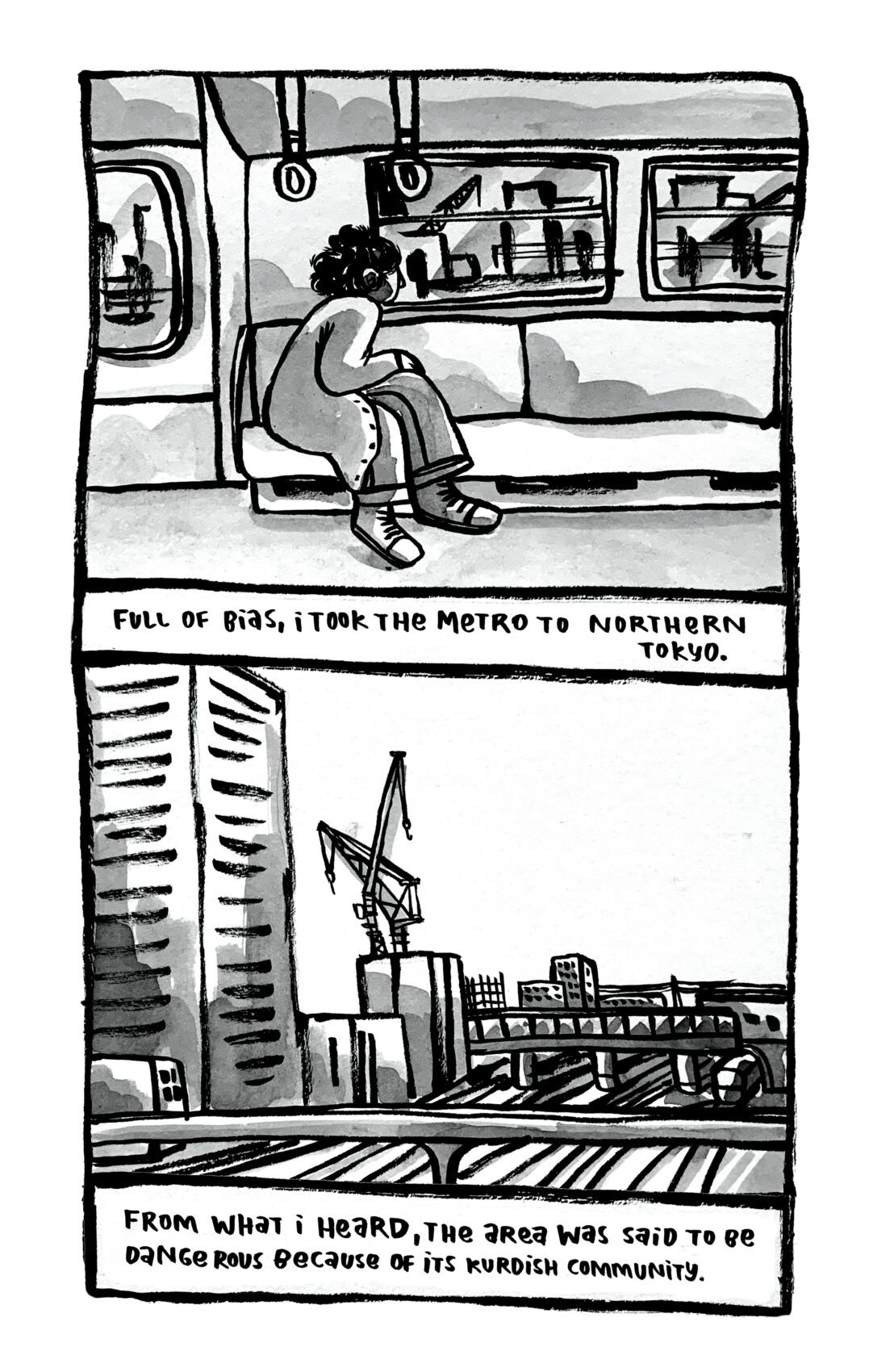
I wanted to experience this country for myself rather than merely viewing it from afar. This led me to travel to Japan on my own initiative in 2024. Once there, I soon realised how greatly my perception of the country was rooted in romanticised images. What I encountered was a society which, in many areas, was more conservative and patriarchal than I had expected.
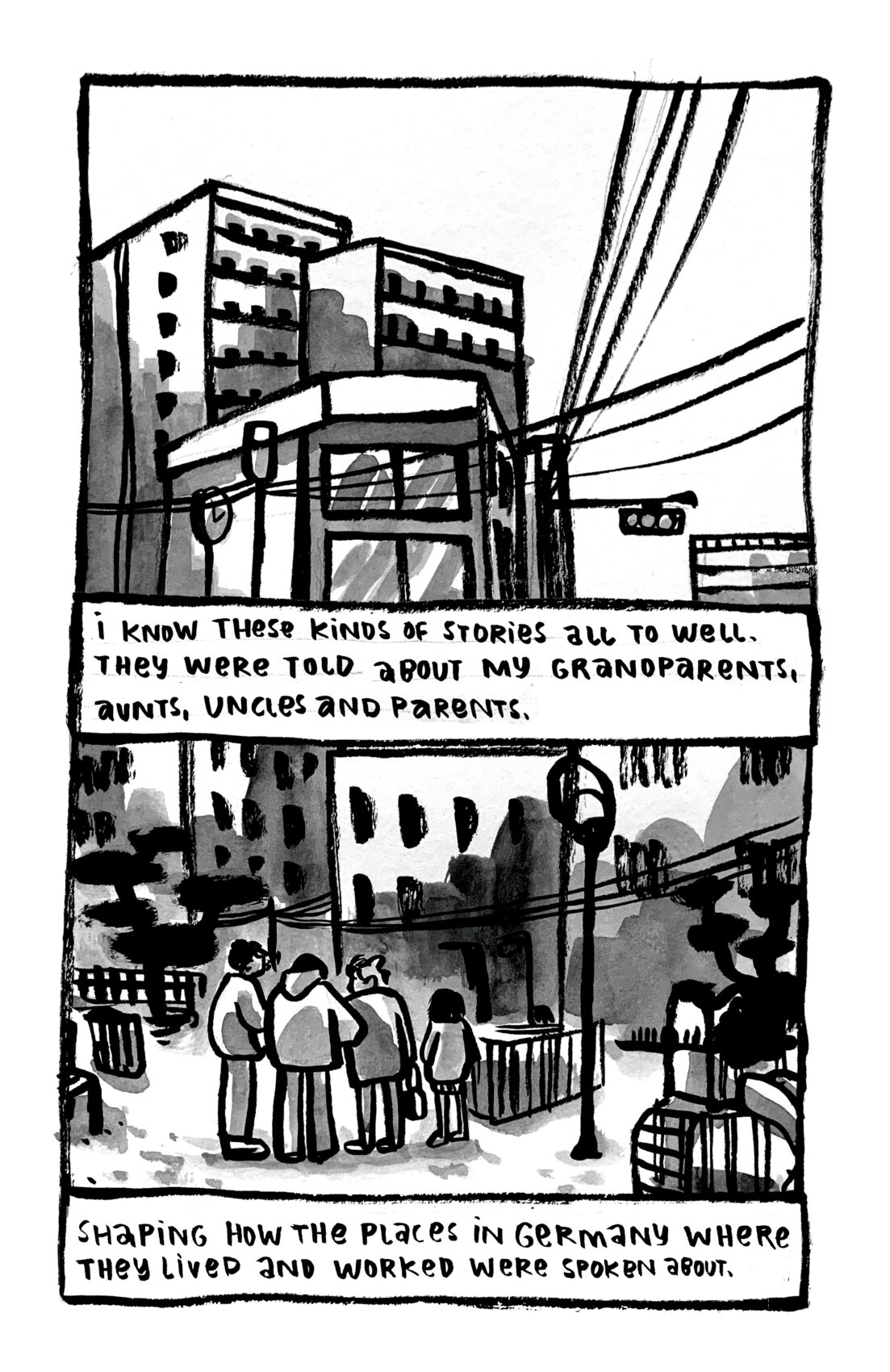
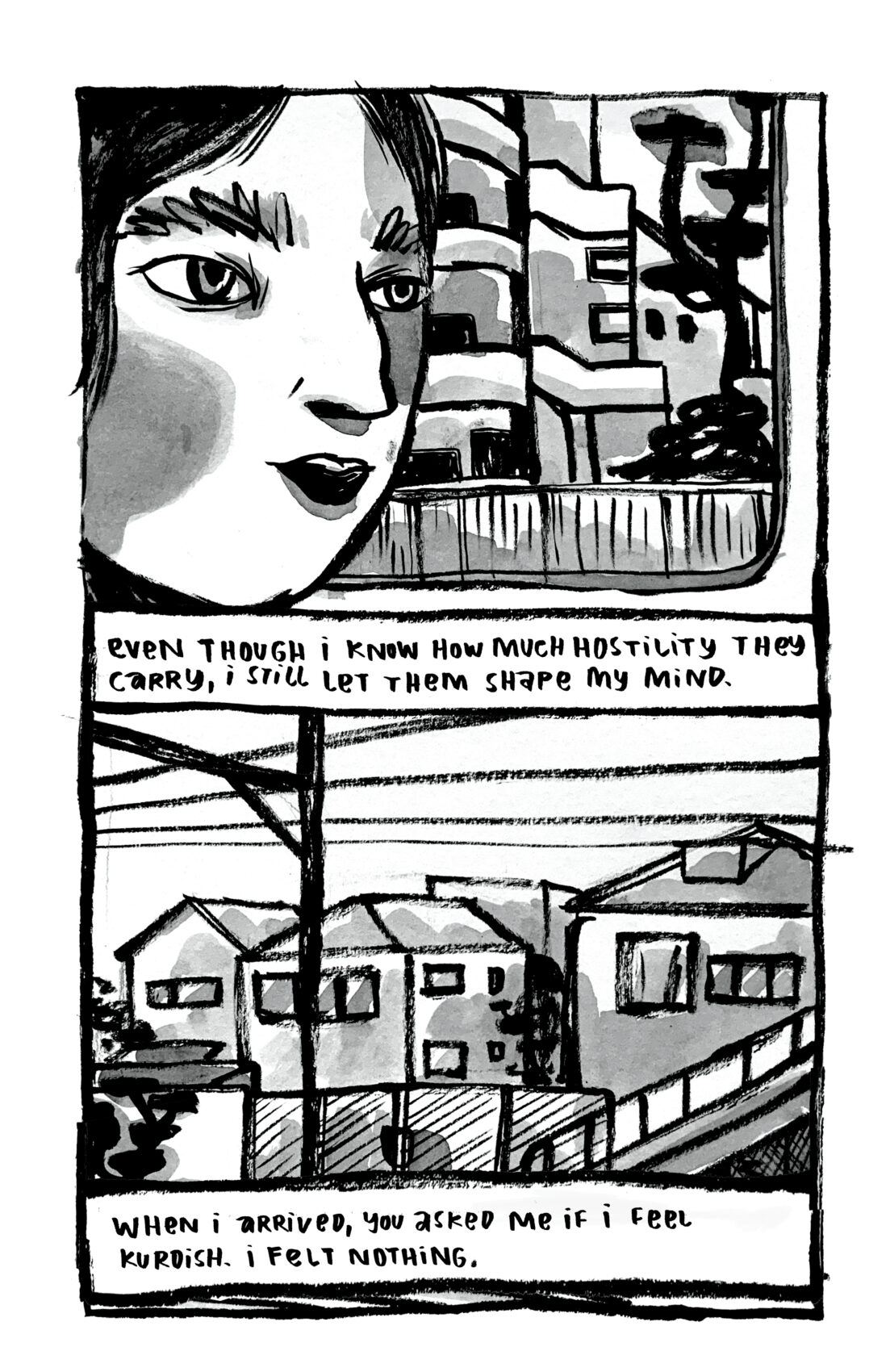
It was this divergence from my expectations that made Japan so interesting for me. Talking to people with an immigrant background made a particularly great impact. Their experience reminded me of stories from my own circle of family and friends. And the way in which the media reported on certain neighbourhoods and communities also rang a bell with me.
At that point, I didn’t have enough time to visit the regions I wanted to find out more about. But I was determined that, the next time I went to Japan, I would start right there, sketchbook in hand, but above all with the intention of listening, observing and understanding.
HKST Your work has been examining labour migration for years – originally focusing on the story of your grandparents in Germany and now looking at migrant workers in Japan. What is it that sustains your interest in this subject?
Koçer I grew up as the daughter of a classic ‘guest worker family’. Because of this, the question of work and belonging has always been a part of my everyday reality. I had a very sheltered upbringing but at the same time always had a feeling of insecurity. For a long time, my family’s existence in Germany was closely tied in with their work. When my grandparents fell ill, this not only meant that they had less income but they were also worried they would no longer be allowed to stay in Germany. And even though this is no longer the case for me personally, the feeling never went away.
For a long time, I never questioned this experience. In my earlier works, it emerged almost subliminally, in minor scenes or parts of a sentence. It was only at the end of my studies that I realised that this combination of work and insecurity was in no way par for the course. I met people whose everyday reality was far removed from mine and gradually became more consciously aware of my own story.
I draw so that I can look at these experiences from a distance and remove them from my own personal level. So it’s no longer just about my family and my personal feeling but rather about a larger social narrative. Individual experiences come together to form a communal pool of experience.
In many cases, my work begins with a look, a gesture, a throwaway sentence, an object or an observation. While I am working on that, other people tell me similar stories. We may be divided by generations, everyday realities or countries but our lives are still touched by the same questions.
HKST As indicated above, you often talk about details – a finger, shoes in front of a door, a moustache. Why is it these seemingly trivial things that channel memories and messages?
Koçer For me, memories rarely stem from major events. I tend to remember little things much more clearly than key dates or historical incidents. For instance, the leather shoes that my grandfather used to clean every evening for work.
It’s details like this that really bring stories to life for me. A pair of shoes tells you who is home, who has left or who is missing. A moustache is not just a moustache but suggests a certain type of person.
I was very shy as a child. I preferred to watch and listen. Even to this day, I still collect moments like these in my sketchbook. Later on, many of my stories stem from moments that I captured in this way.
HKST How do you decide which moments in your sketchbook will become a story – and what form this story will take? How does a comic ultimately take shape from this?
Koçer In my case, it all starts with my sketchbook. In this, I collect everything that arouses my interest: conversations, observations and thoughts but also sentences from books, scenes from films or weird facts from documentaries.
When I’m drawing in my sketchbook, I notice at some point that certain things keep popping up again and again. That’s usually the moment where I start doing a little digging. The more I read up on a subject, the more it consolidates with the drawings in my sketchbook to form a story. After this, I piece together the existing drawings into panels, add missing images and information or texts from my sketchbook.
More often than not, I put the comic to one side for a few days, and if I still think it’s good, I digitalise it. Not every story is told but none are forgotten.
HKST You work in a medium that is often seen as mainstream or accessible. Would you say that this was part of the appeal for you? And maybe the political potential of comics too?
Koçer I like the fact that comics are sometimes underestimated. Many people open up a comic and think it’ll be a quick read. And suddenly they find themselves grappling with a subject that they might otherwise have gone out of their way to avoid. That is the real strength of the medium in my view.
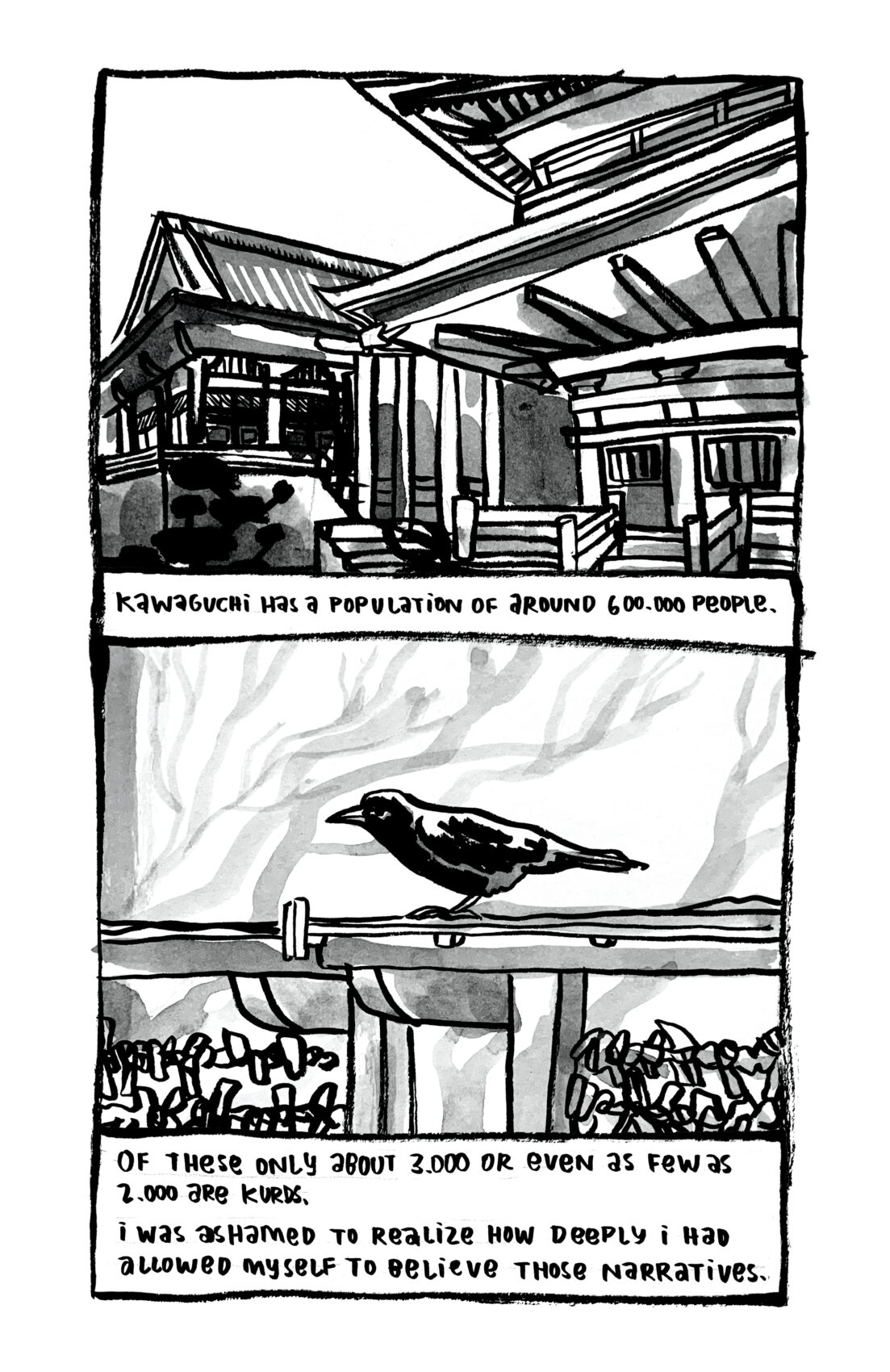
To read a comic, you don’t need to know anything about art or about the subject in question. A single drawing can convey information, emotions and atmosphere at the same time. The pictures and the text don’t have to explain each another – they can complement but even contradict each other. In a series of pictures, they recreate a whole everyday reality with their details. That’s yet another reason why I love working with comics. Sometimes a character’s face says more than their actual words. Or a raven says more about a place in which a tragedy occurred than a lengthy explanation could ever do. And sometimes a single picture conveys a mood that would be difficult to capture in words.
Humour plays a key role here. Readers who chuckle first and then realise a moment later that they’re actually dealing with a serious topic are often willing to take a closer look.
During our visits to Turkey, I would go to the newsagents with my grandfather to look for political caricature and satirical magazines. He never learnt to read properly but was still able to follow political events through the drawings and take part in discussions with other people. Even though I was too young to understand the context at the time, I still spent hours laughing at the exaggerated figures. Looking back, that was probably the first time I had encountered political comics. And maybe it was also the moment in which I understood that humour and social issues were not necessarily at odds with each other but can actually strengthen each other.
Perhaps that’s also why I wish my own works were more humorous. After all, there’s more to life than weighty problems. Even in difficult situations, there are absurd, tender or funny moments. And having all of these at once makes it exciting.
HKST Your works have frequently appeared in explicitly political contexts. For instance Fight was featured in the issue of feminist publication RESIST! at the Women’s Marches in the USA in 2017. And then there was the Alphabet des Ankommens series of comic reportages for the Federal Agency for Civic Education (bpb). And your portraits of the victims of the far-right extremist shooting in Hanau in 2020 were published in German newspaper Der Freitag. For you, where is the line between art and activism – or do you feel that a comic can be both?
Koçer I don’t see comics – or art in general – as being apolitical. Even the decision not to engage with an issue is a stance in itself.
But at the same time, I don’t see my work as activism. I have no wish to tell people what to do or think. Rather, I’m interested in asking questions and drawing attention to perspectives that are often overlooked in everyday life. Perspectives that I find interesting and that might interest other people too.
If a comic leads people to think differently about migration, work or belonging or to discuss these with others, then it has already achieved a great deal as far as I’m concerned. I don’t want to provide answers. What I want is for us all to pay closer attention.
HKST To return to Japan: the Tokyo Art Book Fair last December was the starting point for your travels – and it was here that you discovered other printing and binding methods. Was there anything that surprised you about these East Asian book and printing traditions? And has it changed the way you think about your own comics and zines as physical objects?
Koçer Very much so. I saw the great amount of care that goes into creating books. Paper, binding, folding or even the order in which the pages are turned over are all part of the narrative and not just a means to an end.
Since then, I have been thinking more about how a comic is not just read but experienced as a physical object. A zine is not just an information medium but its materiality is part of the story.
This engagement with materiality is something that I am incorporating into my current project about labour migration in Japan. I believe that a book can tell you something even before you read the first page.